
14
Have you ever been so focused on any job that you have completely lost track of time? Maybe you were designing, writing, solving an issue, or studying, and soon everything seemed to flow efficiently. This mental state is known as “Flow”. And it is where you perform at your best as you are fully focused on the job in front of you. But unfortunately, in this world of emails, constant notifications, and digital distractions, reaching that level of concentration feels harder than ever.
The good news here is that entering the flow state requires much more than just willpower. For instance, your surroundings play a major role in how well you focus. Besides, the websites you access, the way you organize the workspace, the type of music you listen to, and the amount of background noise can support or interrupt your focus. However, you can create the best environment for you by making some intentional changes with practical deep work environment tips. This helps your brain to remain engaged for long periods without getting overwhelmed.
In this blog, we will talk about the best workspace setup for concentration that helps to maximize productivity while minimizing distractions. Read along to know more.
TL;DR
- The flow state is the period of deep concentration where you feel more productive, and work feels easier.
- Limiting digital distractions, reducing noise, and organizing desks can improve your concentration.
- Your workplace also plays an important role in your ability to focus.
- Ambient sounds or instrumental music often help people to focus.
- Browser isolation tools prevent unnecessary website browsing.
- Small changes in the workplace result in longer periods of high-quality and uninterrupted work.
Also read: Mental Decluttering Techniques That Help You Feel Calm, Clear, and Back in Control
What is the flow state?
The flow state is when you are entirely absorbed in the job you are doing.
Your attention stays on that task and the time passes quickly. Distractions fade into the background. You become more productive without forcing yourself to be focused.
Think about the last time you were deeply involved in any project. Maybe it was
- Coding a new feature.
- Writing an important report.
- Reading for an exam.
- Designing artwork.
- Solving a difficult problem.
Hours passed and you didn’t even realize. That is called “Flow”.
However, it often becomes challenging to create the right conditions to improve focus while working.
Importance of your workplace
Many people believe that concentration is just a matter of discipline. However, in reality, your environment has a direct influence on your attention.
Imagine you are trying to work when: your email constantly pops up, your phone buzzes every several minutes, a TV is playing nearby, your desk is cluttered, or social media is just one click away.
Even after your high motivation, these distractions will make your brain switch attention again and again.
According to research from Stanford, chronic multitaskers often find it troublesome to filter out irrelevant information, even when they are not multitasking actively.
This is why it is important to follow deep work environment tips to improve your productivity dramatically. This way, you grow an environment that naturally supports focus instead of depending only on willpower.
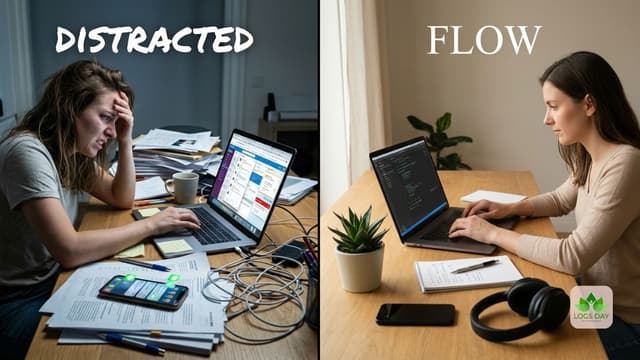
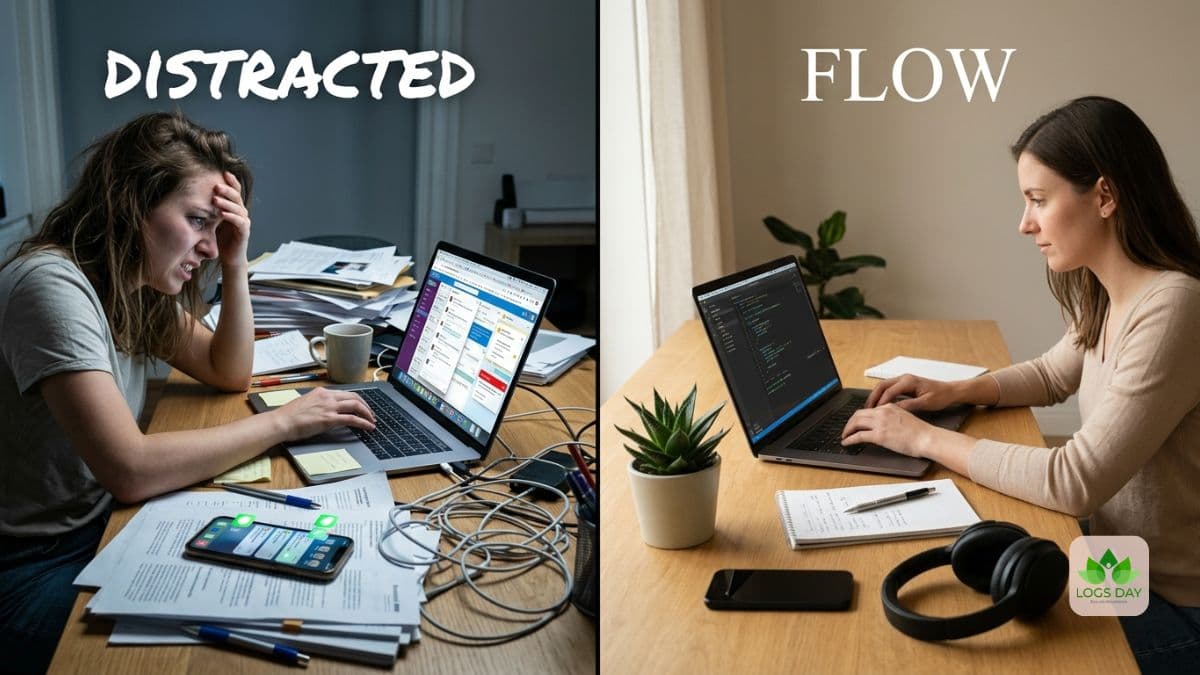
Difference between a focused workspace and a distracted workspace
| Focused workspace | Distracted workspace |
| Clean workspace | Cluttered desk |
| Phone out of reach or silent | Phone notifications |
| Intentional sound environment | Random background noise |
| Protected focus sessions | Continuous interruptions |
| One job at a time | Multiple browser tabs |
Even small developments can make a visible difference.
Begin with reducing noise
Noise is one of the major barriers to deep focus.
Nir Eyal, the speaker and thought leader, mentions that the external triggers that can lead us towards distraction are the rings, the dings, and the things in the outside environment.
In some cases, the noise is quite obvious, like office conversations, construction outside, traffic, or television.
Other times, the distractions are subtle yet damaging.
Background conversations can pull your attention away even without your realization.
It is always recommended to work in a quieter location. If you can’t, then consider using soft earplugs, natural sounds, noise-cancellation headphones, white sounds, or instrumental music.
So, the goal is not to find complete silence. Instead, it is about reducing the unexpected interruptions.
Selecting the right background audio
Not all music brings concentration. Often songs with lyrics compete for attention as your brain processes those words naturally.
Therefore, instrumental audio is always a better choice. You can select from classical music, piano music, rain sounds, Lo-fi beats, ocean waves, ambient electronic music, white noise, brown noise, etc.
Experiment to discover things that work perfectly for you.
Also read: Complete Ergonomics Guide 2026: Perfect Your Home & Office Setup in 10 Steps
Limit all the digital distractions
In some cases, the biggest distraction is not outside the workspace. Instead, it is inside your browser. Think about how often it happens.
For instance, you open the laptop to finish an important job. Immediately you notice: a news headline, a new email, a social media notification, or a YouTube recommendation.
Within minutes, you forget what you were actually planning to do. This is why controlling your digital environment is considered as one of the most helpful deep work environment tips before you start working.
Prepare the workspace before you start
One of the simplest ways to stay focused is to spend two to three minutes preparing your workspace before you begin.
To do this, ask yourself:
- Is my desk clean?
- Do I have all the things I need?
- Have I closed the tabs I don’t need?
- Is my phone on silent mode?
- Do I know the first task to do?
This small routine is a reminder that it is time to focus on work.
So, most of the deep focus productivity tips are not that complicated. They just remove friction before you start.
Importance of working in focus blocks instead of multitasking
Many people think that multitasking helps them to accomplish more. However, the reality is that repeatedly switching between tasks can increase mental fatigue and reduce efficiency.
According to Harvard Business Review, multitasking, juggling, and other types of attention shifting are highly inefficient. The brain works more accurately and much faster when the attention is focused on one thing at a time for a stretch of time.
So, try to work in dedicated focus blocks. To do this, you can follow this pattern.
- Work for around 45-60 minutes.
- Take breaks for 5-10 minutes.
- Get back to another focused session.
During every block, you must silent your notifications, close email, work only one important job, and avoid checking your phone.
These deep work environment tips will give you enough uninterrupted time to enter a deeper level of concentration.
Create a personal focused ritual
Our brains perfectly respond to routines. Maintaining a short ritual before starting work signifies that it is the best time to concentrate.
Your routine might include: putting your headphones on, clearing your desk, taking three slow breaths, beginning instrumental music, writing the most important jobs on a notepad.
So, if you are looking for how to create a distraction-free workspace, all these simple actions create consistency, while making it simpler to enter the “Flow” state every day.
Productive work environment ideas you can follow
There is no need to follow any complete office makeover routine to improve your productivity. Often small changes produce surprisingly big outcomes.
Here are some productive work environment ideas that you can follow:
- Keep your table organized.
- Add a small plant to the desk.
- Face away from the busy walkways.
- Use a desk lamp with warm lighting.
- Maintain a comfortable room temperature.
- Keep all the frequently used items within close reach.
Each of these improvements will remove a small source of distraction. Therefore, it will help your brain to remain focused for longer.
Also read: Mindful Walking: Why Moving Without Your Phone Completely Resets Brain Fatigue
Mistakes that can break your flow
Even though you have a great workspace, some habits can interrupt focus. So, it is better to avoid them.
| Habits that can break your flow | Better alternative |
| Keep social media open | Block all the distracting websites |
| Constantly checking emails | Schedule email times |
| Answering every notification | Silence less important alerts |
| Working in clutter | Organize before beginning |
| Aiming to multitask | Finish one job first |
Protecting your attention is equally important as managing time.
Final thoughts: Your workspace shapes your attention
The majority of people often spend hours looking for better productivity techniques while overlooking the biggest influence on their performance, which is the environment. However, the reality is that your workspace quietly shapes your attention, your habits, and your quality of thinking as well. So, by following practical deep work environment tips like limiting digital distractions, reducing noise, using browser isolation tools, and organizing the desk, you can make it easier to enter the state of deep concentration.
Flow is not something that you wait for. Rather, it is something that you create. By creating intentional habits and removing distractions, you get closer to longer periods of uninterrupted, meaningful work. Eventually, these small changes help you to accomplish more while making you more rewarding, calmer, and less overwhelming. Besides, by protecting your attention, you give yourself the scope to produce the best work every day.
Follow Logsday to get more updates on relevant topics.
Source
https://www.relativity.com/blog/mastering-deep-work-5-strategies-to-improve-your-focus/ https://www.indeed.com/career-advice/career-development/ways-to-improve-focus
https://crestcom.com/blog/2023/10/06/15-ways-to-stay-focused-and-improve-productivity-at-work/
https://www.wojo.com/blog/en/the-toolbox/deep-work-best-practices/