

724
I used to treat mornings as something to survive. Alarm off, phone on, coffee in hand within four minutes, and straight into emails before I'd even brushed my teeth. I thought my 11 PM tossing and turning was a nighttime problem. It took a sleep coach pointing out that everything I did between 6 and 10 AM was actively working against me for me to understand that a morning routine for better sleep isn't a wellness trend, it's biology. What you do in the first two hours of your day helps decide how well you will sleep sixteen hours later.
Most sleep advice focuses exclusively on bedtime. Avoid screens, dim the lights, adjust the ideal sleep temperature, and take a warm bath. All valid. But none of it fully compensates for a morning that has already dysregulated your cortisol, suppressed your melatonin cues, and thrown your circadian rhythm off by hours. Your body runs on a precise internal clock, and that clock is set in the morning, not at night.
Your Circadian Clock Is Reset Every Single Morning Whether You Like It or Not
To learn how morning affects sleep quality, it is important to first understand the circadian rhythm, the approximately 24-hour internal process that determines when you feel awake, when you feel sleepy, and when melatonin is released. The clock is initialized and synchronized on a daily basis through environmental signals, and the strongest signal occurs in the morning.
The circadian rhythm morning routine is effective by aligning your internal clock with a regular external stimulus. As you wake up at the same time every day and expose your brain to the right things at the beginning of the day, your brain learns exactly when to start counting down till you fall asleep. disturb in the morning, and you disturb in the night.
The Single Most Powerful Thing You Can Do Before 8 AM
Morning sunlight for sleep is not just a simple wellness tip. It is one of the most scientifically supported ways to improve sleep, apart from maintaining a regular sleep schedule. The natural light hitting your retinas within the first thirty to sixty minutes of waking sends a direct signal to the brain master clock that then employs that signal to number the melatonin release signal fourteen to sixteen hours later. This is an important part of a morning routine for better sleep because it works with your brain in a way that supplements cannot match.
There is adequate outdoor exposure to light (two to ten minutes) on clear days. During cloudy days, fifteen to twenty minutes. Do it first, before checking your phone, before coffee, before anything.
Also read: 17 Foods That Help You Sleep Better Tonight (Backed by Nutritional Science)
What You Eat for Breakfast Is Already Influencing Tonight's Sleep
The connection between breakfast and sleep is closer than most people think. The precursor of serotonin and ultimately melatonin is the amino acid tryptophan, which is found in eggs, turkey, dairy, nuts, and seeds. In the morning, eating foods rich in tryptophan will provide your body with raw materials for making melatonin by the evening. Sources of magnesium, such as spinach, pumpkin seeds and bananas, aid muscle relaxation and the nervous system’s capacity to revert to a sleep state. A protein-based, low-carb breakfast not only works great on the energy level but is a direct investment in the quality of the sleep you are going to have that night and a silent and yet efficient part of any morning routine for better sleep.
Why the Gym at 7 AM Beats the Gym at 7 PM Every Time
One of the most underestimated morning habits is exercising with a morning wellness routine, which enhances sleep in an impressive manner and regularly. Exercises like simple walking and stretching elevate body temperature and activate the sympathetic nervous system, both of which are suitable in the morning, but which are in direct opposition to when stimulated by exercise in the two to three hours before sleep.
Research has revealed that morning exercisers sleep more quickly, have more deep sleep, and wake less often at night. It is exactly in this manner that morning influences the quality of sleep that exercise can have, which is to schedule the stress and temperature reaction of the body so that it reaches its peak early in the day and gets fully resolved by bedtime. The difference can be felt even in a thirty-minute walk before noon.
Also read: Why Comfort Zones Shrink Over Time
The Caffeine Rule That Most People Get Wrong
The half-life of caffeine ranges between five and seven hours, meaning that a cup of caffeine consumed at noon would still have half of its stimulating properties left in the evening. This is one of the most practically important facts in any morning routine for better sleep.
Sleep researchers generally advise against consuming any caffeine after 1 PM. It is also important to wait at least ninety minutes after waking to have your first cup. Cortisol naturally peaks during this period, and consuming caffeine during this period will increase tolerance more quickly and will cause greater consumption later in the day. Wait until the first cup, and sleep is better without any inducement.
Hydration, Cold Showers, and the Habits Nobody Talks About
Drink about 400–600 ml of water before your coffee in the morning. It helps your body rehydrate after a night of sleep. This can improve your energy levels and may prevent the tired feeling that often happens in the afternoon, reducing the need for extra caffeine later in the day. Reducing fluid intake after 6 PM decreases the number of awakenings in the middle of the night to go to the bathroom - a small change that silently enhances sleep onset and duration.
Sixty to ninety seconds of a cold shower provokes a moderate amount of stress, which peaks in the morning and completes its action by evening, enhancing a vagal tone and helping your nervous system to downregulate better at night. These are a few of the most underrated morning habits that improve sleep.
Also read: The Psychology of Avoiding Difficult Conversations
The Screen Habit That Is Destroying Your Sleep Before You Even Get to Bed
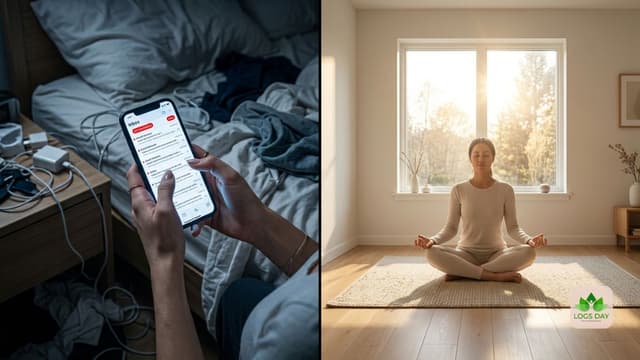
Looking at your phone within five minutes of rising saturates the brain with artificial blue light and information-activated cortisol before the nervous system has naturally oriented itself. This raises baseline anxiety hours and is in direct competition with the natural cortisol-awakening effect of your body. A morning routine for better sleep is a safeguard of the initial thirty minutes after waking as an unrestricted zone - no social networking, no news, no emails. This boundary is necessary to sleep by the morning sunlight and to have circadian health. First, there is light, water, and movement. Waking up with a clean stress response means you can really make your nervous system take a real break by evening.
How You Handle Stress Before Noon Determines How Easily You Fall Asleep
Unprocessed stress in the morning will be piled throughout the day and will reach bedtime in the form of a racing mind. An actual circadian rhythm morning routine for better sleep incorporates a short meditative practice of intentional stress management for five minutes of journaling, ten minutes of breathwork, or a short meditation after waking. This suppresses the cortisol baseline, enhances heart rate variability, and develops a neurological buffer to the stressors of the day. Most of the population is only interested in evening relaxation. The nervous system must be anchored at the end of the day, and a clear, deliberate morning will be the basis of a clear evening.
Also read: Gua Sha Facial Massage: How Gua Sha Can Sculpt Your Face and Boost Your Health Naturally
What the Experts Say About Mornings and Sleep
Dr. Andrew Huberman, neuroscientist at Stanford University and host of the Huberman Lab podcast, has consistently identified morning light exposure and a delayed caffeine window as the two highest-leverage tools for regulating the circadian system and improving sleep quality naturally. He notes that morning sunlight for sleep works specifically because the low-angle light of early morning activates melanopsin-containing retinal cells in a way that midday or artificial light cannot replicate.
On the other hand, Dr. Matthew Walker, neuroscientist and author of Why We Sleep, similarly emphasizes that a consistent wake time, more than even a consistent bedtime, is the single most stabilizing anchor for the circadian clock, and that a structured morning routine for better sleep is where lasting sleep improvement actually begins.
Also read: Running vs Walking for Belly Fat: Which One Really Targets Belly Fat Faster?
Simple Morning Schedules That Actually Work
An easy morning routine for better sleep does not need to be elaborate. To those who have half an hour: always get up on time, drink a glass of water, get ten minutes of natural light, and take screen break within the first twenty minutes. Sixty minutes: include a twenty-minute stroll and five minutes of journaling before opening any screens. Ninety minutes: add breakfast rich in tryptophan, a cold shower finish, and 15 minutes of breathwork with a full caffeine hold. The three share the same non-negotiables… a consistent wake time, early exposure to light, late caffeine, and no screen time in the first window.
These habits create the base for morning habits that improve sleep. They require no equipment or dramatic lifestyle overhaul to begin tomorrow.
Continue your journey with Logsday to get interesting updates on personal development and practical wellness.
Every article here is created to support a more authentic, grounded life.
Sources
- https://www.ncbi.nlm.nih.gov/pmc/articles/PMC4334454/
- https://www.ncbi.nlm.nih.gov/pmc/articles/PMC3962308/
- https://www.ncbi.nlm.nih.gov/pmc/articles/PMC5409704/
- https://www.ncbi.nlm.nih.gov/pmc/articles/PMC4702189/
- https://hubermanlab.com/master-your-sleep-and-be-more-alert-when-awake/
- https://themattwalkerpodcast.buzzsprout.com/1821163/9896578