1345
Staying fit does not always require a gym membership or expensive machines. Many people are now discovering that a home workout plan with no equipment can be just as effective as traditional gym training. You can get stronger, last longer, and stay active at home with the right exercises and a simple routine.
I started looking into home workouts when I was really busy and didn't have time to go to the gym. I was surprised that those short sessions at home made me feel stronger and more energetic than I thought they would. The simplest routines can sometimes make the biggest changes in our daily lives.
A well-designed home workout plan with no equipment uses bodyweight exercises. Your own body is what makes these movements hard. They are easy, safe, and good for people who are just starting out or who are already very fit.
We will help you make a routine that you can stick to. This guide will show you everything you need to know, step by step, whether you're just starting to get fit or want a structured home exercise routine.
Fitness Can Start Right Where You Are
Before explaining the program, I want to share something from my own experience. A few years ago, I decided to follow a home workout plan with no equipment because I didn't have time to go to the gym on a regular basis.
At first, I wasn't sure if these kinds of workouts would work. But after a few weeks, I noticed that my muscles were stronger, my stamina was better, and I could concentrate better at work.
Another surprising benefit was that things stayed the same. When you work out at home, you can't make excuses. No waiting for equipment or traveling.
I can still do a quick workout and stay active, even on busy days. That experience taught me that doing simple bodyweight exercises can really change how we feel every day.
Also read: 35 Self-Care Ideas for Busy People: 5-Minute to 1-Hour Activities by Category
Benefits of Bodyweight Training
Bodyweight exercises are very effective because they work out many muscles at once. They don't just work on one muscle; they build functional strength that helps with everyday tasks.
Here are some of the best things about bodyweight workouts:
- Improve strength without machines
- Build flexibility and balance
- Reduce risk of injury with natural movements
- Save money on gym memberships
- Allow workouts anywhere, anytime
Another great advantage is adaptability. You can easily turn these exercises into a beginner-friendly workout at home for beginners, or make it harder to challenge more experienced athletes.
Bodyweight workouts are also great for people who want a practical no gym workout plan. They don't take up much space and can fit into any way of life.
The most important thing is that these workouts can be done over and over again. It's easier to stick with exercise for months or even years when it feels easy and accessible.
Warm-Up Routine Before Every Workout
It's very important to warm up your muscles before you work out. A good warm-up gets the body ready to move and lowers the risk of injury.
A simple warm-up should only take 5 to 8 minutes.
Try these exercises before your workout:
- Jumping jacks – 30 seconds
- Arm circles – 30 seconds
- High knees – 30 seconds
- Bodyweight squats – 15 reps
- Light jogging in place – 1 minute
These movements make your muscles work and get your blood flowing. They also help your body get ready for the workout.
I can feel the difference right away when I skip a warm-up. Taking a few minutes to get ready can make the whole workout feel better and go more smoothly.
After warming up, you can start the main session of your home workout plan with no equipment.
.
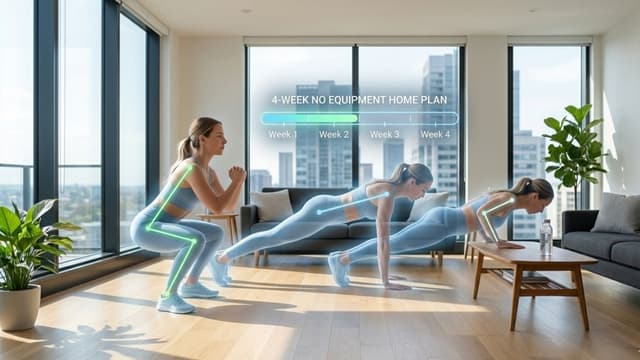
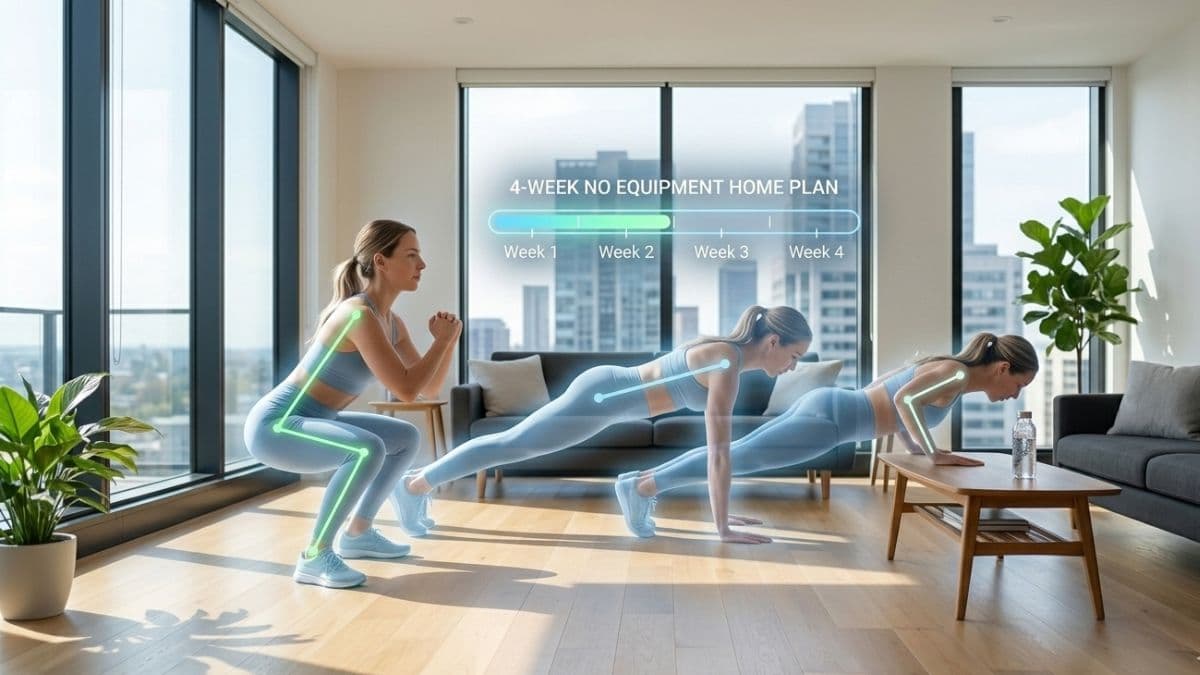
4-Week Progressive Bodyweight Workout Plan
A structured program helps your body get better little by little. This four-week plan gradually makes things harder so that your muscles can safely get used to it.
Week 1 – Foundation
Focus on learning correct movement and building basic strength.
Exercises are:
- Squats – 3 sets of 10
- Push-ups – 3 sets of 8
- Plank – 20 seconds
- Lunges – 3 sets of 8 each leg
- Glute bridges – 12 reps
Most people are following home workout no equipment approach for the first time during this phase. The point is to get used to the movements.
Week 2 – Strength Building
Now your body starts to change. Add a few more repetitions.
Workout routine:
- Squats – 12 reps
- Push-ups – 10 reps
- Plank – 30 seconds
- Step-back lunges – 10 each leg
- Mountain climbers – 20 reps
This stage slowly transforms your routine into a structured bodyweight workout plan that improves endurance and coordination.
Week 3 – Endurance and Control
By now, your endurance will improve. This week is all about longer sets and better control.
Exercises are:
- Jump squats – 12 reps
- Incline push-ups – 12 reps
- Plank shoulder taps – 20 reps
- Walking lunges – 12 each leg
- Bicycle crunches – 20 reps
These movements strengthen the core and lower body while improving stability.
Week 4 – Advanced Bodyweight Challenge
The final week increases intensity and builds confidence.
Exercises:
- Pistol squat progressions – 8 reps
- Decline push-ups – 12 reps
- Plank hold – 45 seconds
- Burpees – 10 reps
- Russian twists – 20 reps
At this stage, you are effectively practicing calisthenics at home, using your body weight to build full-body strength.
This final week shows how powerful a simple home workout plan with no equipment can be when followed consistently.
Also read: Intermittent Fasting in 2026: Benefits, Risks, Methods & Who Should Avoid It
Beginner, Intermediate, and Advanced Tracks
Everyone has a different level of fitness when they start. The most important thing is to pick the right level of intensity.
Use these tracks to change your routine:
- Beginner: 2–3 sets per exercise with longer rest
- Intermediate: 3–4 sets with moderate rest
- Advanced: 4–5 sets with minimal rest
Newbies should focus on learning how to do things right. People who are at an intermediate level of training can do more reps and control the speed of their workouts.
People who are more advanced can add explosive moves and make circuits out of exercises. This flexible system allows the home workout plan with no equipment to work for almost everyone.
Exercise Library with Form Tips
It's better to have the right form than to do a lot of reps. Using the right technique keeps your joints safe and helps your muscles work better.
Here are some common bodyweight exercises and tips on how to do them right:
Push-ups:
![[image]](https://admin.logsday.com/storage/media/Push-ups_2026-03-06_17-06-49_cwc9D8fm.jpg)
Push-ups are a great way to work out your arms, chest, and shoulders. Put your hands a little wider than your shoulders and start in a high plank position. Your body should be straight from your head to your heels. Don't let your hips go up or down too much. Bend your elbows slowly and lower your chest toward the floor. Then push your body back up. While doing the exercise, move in a controlled way and breathe normally.
Squats:
![[image]](https://admin.logsday.com/storage/media/Squats_2026-03-06_17-08-24_sS1EvdwL.jpg)
Squats make your legs and glutes stronger. Put your feet about shoulder-width apart. Your back should be straight and your chest should be up. Push your hips back slowly, like you're sitting in a chair. Bend your knees and lower your body until your thighs are almost parallel to the ground. Make sure your knees don't go too far forward. Then slowly get back up. During the exercise, move slowly and stay balanced.
Plank:
![[image]](https://admin.logsday.com/storage/media/Plank_2026-03-06_17-10-01_DeDUaEAz.jpg)
The plank is a simple but effective way to work out your core muscles. Put your forearms on the floor and stretch your legs out behind you to start. Your body should be in a straight line from your head to your heels. Keep your back flat and tighten your stomach muscles. Don't let your hips drop or your back arch. As long as you can, stay in this position while breathing normally and keeping your body still.
Lunges:
![[image]](https://admin.logsday.com/storage/media/Lunges_2026-03-06_17-13-04_bWnGnF7H.jpg)
Lunges are a great way to build strength in your legs and improve your balance. Put your feet together and stand up straight. Put one foot in front of the other. Bend both knees slowly and lower your body toward the floor. Your back knee should move down slowly, and your front knee should stay above your foot. During the movement, keep your upper body straight. Then push through your front foot and go back to where you started. Do the same thing with the other leg.
Glute bridge:
![[image]](https://admin.logsday.com/storage/media/Glute_bridge_2026-03-06_17-15-23_fhkRtFiv.jpg)
The glute bridge is a great way to work out your lower back and glutes. Put your knees up and your feet flat on the floor while you lie on your back. Let your arms hang down by your sides. Press your feet into the floor and slowly lift your hips toward the ceiling. At the top, squeeze your glutes as hard as you can and hold for a second. Then, slowly bring your hips back down. Move slowly and with purpose.
Learning correct form transforms simple movements into an effective home fitness program.
I notice that my muscles work better when I do these exercises slowly and carefully. Doing repetitions quickly almost never gives the same results.
Also read: The Gut-Brain Connection: How Your Stomach Controls Your Mood, Anxiety & Focus
Weekly Workout Schedule (3–5 Days)
Intensity isn't as important as consistency. Pick a schedule that works with your life.
A weekly schedule example:
- 3 days/week: Full body workouts
- 4 days/week: Upper body + lower body split
- 5 days/week: Add core and cardio sessions
Most beginners start with three sessions a week. You can slowly increase the frequency as your strength gets better.
This organized method makes it easy to stick to your home workout plan with no equipment.
This system is easy to follow, even for busy professionals who don't want to change their daily routine.
Cool-Down Routine After Exercise
Cooling down helps muscles heal and makes them less stiff after working out. Take five minutes to stretch the big muscle groups.
These stretches might help:
Hamstring Stretch – 30 Seconds
![[image]](https://admin.logsday.com/storage/media/Hamstring_Stretch_2026-03-06_17-19-30_LOF8ZQJ6.jpg)
The hamstring stretch helps relax the muscles in the back of your thighs. These muscles often get tight after sitting for a long time or after walking or working out. You need to sit on the floor with one leg straight and the other bent to do this stretch. Slowly lean forward and try to touch your toes. Don't push your body. Just stretch until you feel a light pull behind your thigh. Breathe slowly and hold the position for about 30 seconds. This stretch makes your muscles more flexible and less stiff. Doing it often can also lower the chance of hurting small muscles.
Quad Stretch – 30 Seconds
![[image]](https://admin.logsday.com/storage/media/Quad_Stretch_2026-03-06_17-24-13_Lch08r6J.jpg)
The quad stretch works the muscles in the front of your thighs. These muscles have to work hard when you walk, climb stairs, and do a lot of other things every day. To do this stretch, stand up straight and hold on to a wall or chair for support. With your hand, bend one knee and gently pull your foot toward your back. Keep your knees close together and your back straight as much as you can. Breathe normally while you hold the stretch for about 30 seconds. You should feel a light stretch in the front of your thigh. This stretch helps your muscles relax after working out, makes them less tight, and makes it easier for you to move.
Shoulder Stretch – 30 Seconds
![[image]](https://admin.logsday.com/storage/media/Shoulder_Stretch_2026-03-07_14-46-31_Fhyuf6th.jpg)
The shoulder stretch helps the muscles around your upper back and shoulders relax. These areas often get tight when you work on a computer, use a phone, or carry a bag. To do this stretch, cross one arm over your chest and hold it with the other hand. Gently pull the arm closer to your body until you feel a mild stretch in your shoulder. Don't lift your shoulders up; instead, keep them relaxed. While you stretch, take slow, deep breaths for about 30 seconds. This easy move makes your shoulders more flexible and helps ease stiffness. Stretching on a regular basis can also help with posture and comfort.
Child’s Pose – 30 Seconds

The child's pose is a gentle stretch that helps the back, hips, and shoulders relax. It also helps the mind relax. First, get down on your knees and sit back on your heels. Bend forward slowly and lower your forehead toward the ground while stretching your arms out in front of you. In this position, let your body relax. While you hold the pose, take deep, slow breaths for about 30 seconds. This stretch helps to relax the lower back and hips. A lot of people say it helps them relax after working out or a long day. It also helps you relax and get rid of stress.
Deep Breathing – 1 Minute

Taking deep breaths can help you relax and calm down. It's a simple but effective way to lower stress and get more oxygen to your body. Get comfortable by sitting or lying down. You can close your eyes if you want. Breathe in slowly through your nose and let your stomach get bigger. Then slowly let the air out of your mouth. For about a minute, pay attention to your slow, steady breathing. This helps your muscles relax after you stretch or work out. It can also help you focus and think clearly. A short session of deep breathing can make a lot of people feel better and more balanced.
Stretching after working out helps your body relax. It also makes you more flexible over time.
I like the cool-down phase because it ends the workout on a calm note.
Progress Tracking and Motivation
Keeping track of your progress will keep you going. Over time, small changes add up to big results.
There are easy ways to keep track of your workouts:
- Record repetitions and sets in a notebook
- Take progress photos every two weeks
- Measure endurance improvements
- Track body measurements
I saw steady progress week after week when I started keeping track of my workouts. Even small changes felt good.
A consistent home workout plan with no equipment can become much more effective when you measure your progress regularly.
Also read: Why Do You Wake Up at 3AM Every Night? 11 Causes and How to Stop It
Common Mistakes to Avoid
People often make little mistakes that slow them down. You will see results faster if you don't make these mistakes.
Common mistakes are:
- Skipping warm-ups
- Using incorrect exercise form
- Doing too many workouts without rest
- Ignoring recovery and sleep
It's much more important to be consistent and use the right technique than to be very intense.
Simple routines can work wonders when done right.
Expert Insights on Home Workout Plans Without Equipment
Fitness experts often say that bodyweight training is a great way to stay active at home. Bodyweight exercises like squats, push-ups, and lunges mimic movements we do every day and help us get stronger and more flexible, says certified trainer Ben Walker. He says that these exercises "improve your functional fitness because they mimic movements you do in real life and work out several muscle groups at once." The ACSM's Health & Fitness Journal also talks about research that shows bodyweight training teaches people how to control and stabilize their own bodies, which makes movement more natural and efficient. Experts also say that these kinds of exercises make it easier to get fit because they don't need any machines or equipment.
Fitness coaches also say that bodyweight workouts work many muscles at once, which helps with balance, flexibility, and overall fitness. Kim Perry, a trainer, says that many movements that don't use equipment work out multiple muscle groups at the same time, making the workout more effective for the whole body.
Nutrition Guide to Support Home Workouts
Exercise works best when supported by proper nutrition.
Focus on balanced meals that include:
Protein – eggs, lentils, chicken, tofu
Healthy carbohydrates – rice, oats, whole grains
Healthy fats – nuts, seeds, olive oil
Fruits and vegetables for vitamins
Hydration is also important. Drinking enough water improves energy and recovery.
Simple nutrition habits can amplify the benefits of your home workout plan with no equipment and help you stay energized throughout the day.
Building Strength Without a Gym
Fitness does not need complicated equipment or expensive memberships. A simple home workout plan with no equipment can get you great results if you stick with it.
Anyone can build strength at home with structured training, good warm-ups, and a balanced diet. The most important thing is to start small and stick with it. Health, energy, and confidence can all get better with even short daily sessions.
Start today, be patient, and let your body get used to the changes over the next few weeks.
Stay inspired and discover more simple fitness, lifestyle, and personal growth tips only on Logsday.
Also read: 17 Foods That Help You Sleep Better Tonight (Backed by Nutritional Science)
Sources
- https://darebee.com/
- https://www.nutrisense.io/blog/no-equipment-home-workout-plan
- https://www.nourishmovelove.com/category/workouts/move-blog/workout-calendars/
- https://www.nerdfitness.com/blog/the-7-best-at-home-workout-routines-the-ultimate-guide-for-training-without-a-gym/
- https://www.nbcnews.com/better/lifestyle/30-day-strength-training-routine-no-equipment-required-ncna988936