
543
I will be honest. I bought resistance bands on a whim during a trip, stuffed them into my bag, and assumed they would gather dust beside every other impulse fitness purchase I had ever made. Six weeks later, they had become the only workout equipment I was consistently using. This article covers what a full body resistance band workout actually delivers, what the research says about why it works, and how to build a routine whether you are starting from zero or looking to train smarter with less.
Why Resistance Bands Deserve More Credit
Resistance bands are often marketed as beginner tools or rehabilitation aids, which undersells them significantly. The tension a band provides is not fixed the way a dumbbell is. It increases through the range of motion, which means the muscle is challenged at the point where it is strongest rather than only at the weakest point of the lift.
Dr. James Colado, professor of exercise science at the University of Valencia, has published research comparing band-based training to free weight training and found comparable gains in muscular strength and endurance across multiple muscle groups. His findings confirm that strength training using bands produces measurable hypertrophy and functional strength improvements, particularly in populations new to resistance training or returning after a break. For anyone exploring resistance band exercises for beginners, this is a meaningful starting point: you are not working with a lesser tool.
Also read: Transcendental Meditation Explained: What It Is, How It Works, and Whether It’s Worth Trying
Building a Full Body Resistance Band Workout: The Structure
A well-designed full body resistance band workout follows the same structural logic as any effective strength session: compound movements first, isolation work second, and enough volume to stimulate adaptation without exceeding recovery capacity.
For a home workout with resistance bands, the following movement pattern covers every major muscle group with minimal equipment and no need for a rack, bench, or floor space beyond what a yoga mat provides.
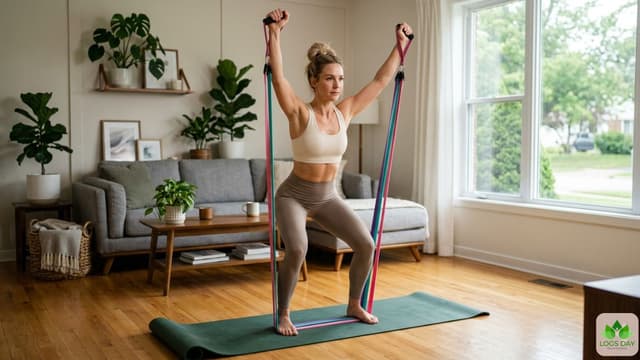
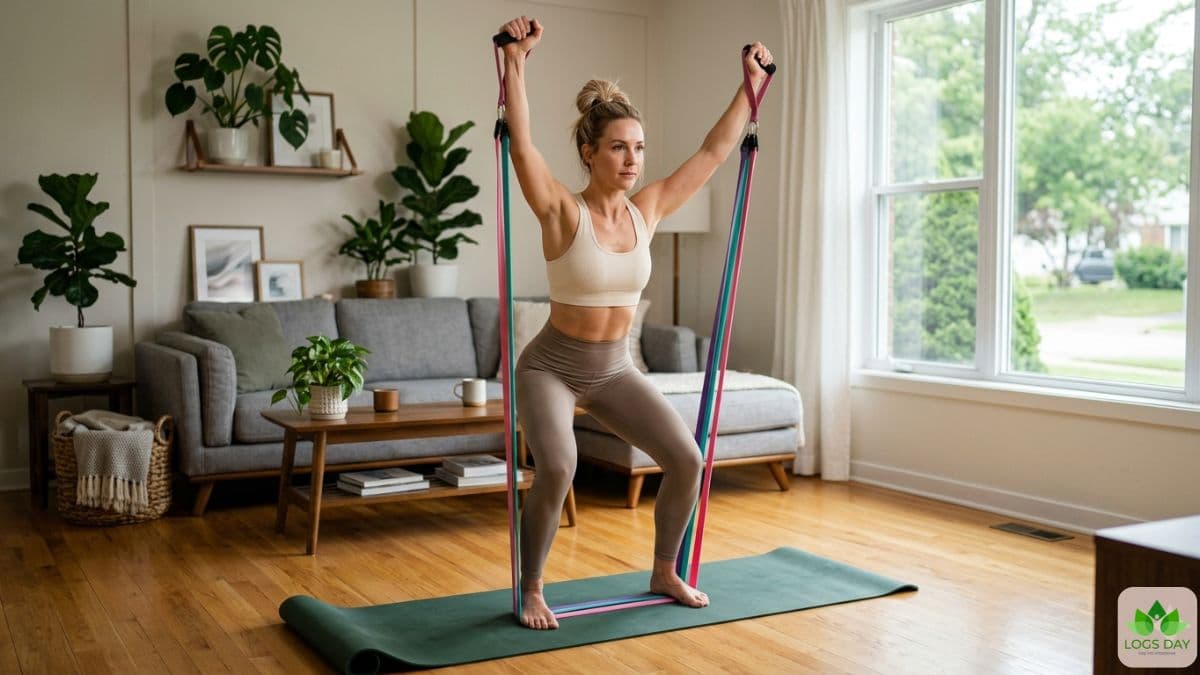
Squat to press: Anchoring the band under both feet and pressing overhead at the top of the squat trains the legs, glutes, shoulders, and core in a single movement. This is the most time-efficient exercise in any portable fitness equipment workout because it demands full-body coordination rather than isolated effort.
Bent-over row: Standing on the band with a hip hinge and rowing both handles toward the ribcage trains the upper and mid-back, rear deltoids, and biceps.
Chest press: Looping the band behind the back and pressing forward trains the chest and triceps with variable resistance that increases at full extension, the point at which traditional push-ups become easiest and least productive.
Deadlift: Standing on the band and hinging to full hip extension targets the posterior chain: hamstrings, glutes, and lower back — the foundational pull pattern that transfers most directly to everyday movement and injury prevention.
Pallof press: Fixing the band at chest level and pressing it forward while keeping your body from rotating helps build strong anti-rotation core stability.
Also read: Walking Meditation Guide: How to Start, What to Expect, and Why It Works
Resistance Band Exercises for Beginners: What to Do First
Resistance band exercises for beginners should prioritise movement quality over load. Bands offer a natural advantage here: the resistance is lower at the start of the movement, which allows a beginner to learn the pattern before the load becomes truly challenging.
Start with two sessions per week, three sets of ten to twelve repetitions per exercise, and a band that allows you to complete the set with good form while still feeling challenged by the final two repetitions. When twelve repetitions feel manageable across all three sets, move to a heavier band or increase to four sets.
Dr. Brad Schoenfeld, professor of exercise science at Lehman College and one of the world's leading researchers on muscle hypertrophy, has noted in published research that the specific load used matters far less than whether the set is taken close to muscular failure. "Resistance training with lighter loads taken to or near failure can produce gains in muscle mass similar to heavier loading schemes," his team concluded across multiple studies. This is particularly relevant for resistance band exercises for beginners: starting light is not a limitation. It is a legitimate and effective training stimulus.
Portable Fitness Equipment Workouts: The Case for Bands Over Everything Else
I have trained in gyms, with dumbbells at home, with kettlebells, and with bodyweight alone. The portable fitness equipment workouts I have built around resistance bands are the only ones I have maintained consistently while travelling, and consistency is the variable that determines every long-term fitness outcome.
A full set of resistance bands covering light, medium, and heavy resistance weighs under a kilogram and fits in a side pocket of a backpack. They require no maintenance, make no noise, and can be used in a hotel room, a garden, or a park without setup time.
The American College of Sports Medicine (ACSM) has consistently included resistance bands on its list of evidence-based tools for improving muscular fitness across both clinical and recreational populations. In its physical activity guidelines, the ACSM notes their particular utility for people with limited access to traditional gym equipment, citing strong adherence rates and low injury risk as key advantages of portable fitness equipment workouts built around bands.
Low Impact Resistance Band Routine: Who Benefits Most
A low impact resistance band routine is not only for people managing injury or pain. It is appropriate for anyone whose joints respond poorly to heavy compressive loads, anyone returning to training after time off, and anyone who wants to maintain strength and mobility without the recovery demands of heavier training.
Also read: The Psychology of Overexplaining Yourself
How to Make a Full Body Resistance Band Workout Stick
The main reason most home workouts fail is a lack of proper structure. Without a gym commute, fixed class time, or a trainer expecting you, you have to motivate yourself and decide to work out every single time.
Two things help. First, keep your bands visible. Keeping them on a hook, a door handle, or beside your mat makes it easier to get started, removing the small setup effort that often stops people from training at home. Second, anchor the workout to an existing routine. Working out right after your coffee, before your shower, or at the same time during your workday will help you stay consistent by removing the daily decision-making that often weakens habits.
A full body resistance band workout does not require a dedicated training space, an hour of free time, or any equipment beyond a set of bands and a door anchor. That accessibility is not a compromise. For most people in most life situations, it is the reason the habit finally sticks.
Also read: How I Discovered the Real Gratitude Practice Benefits (and Why I Will Never Stop)
Anyone can start with full body resistance band workout, with no membership fee and no dedicated space required. The hardest part is starting. For more practical wellness content, follow Logsday.
Source
- https://www.acsm.org/education-resources/trending-topics-resources/physical-activity-guidelines
- https://www.mcgillresearch.com/
- https://pubmed.ncbi.nlm.nih.gov/12430990/
- https://journals.humankinetics.com/view/journals/japa/japa-overview.xml
- https://pubmed.ncbi.nlm.nih.gov/31166138/
- https://www.hss.edu/professionals_chiaia-theresa.asp