
477
Making decisions is an important part of daily life. Every day, we choose everything from what to wear to how to handle a big task at workplace. When we have too many choices or options, it’s very easy to feel stuck or stressed out.
That is why a decision-making framework guide is so helpful. Though it sounds like a big term, but it’s actually just a simple plan which will definitely help you think clearly.
What is a Decision-Making Framework?
You can think of a framework as a checklist for your brain. Instead of just guessing or letting your emotions take over, all you have to do is follow a few basic steps to find the best answer.
It is a lot like using a map. If you are in a new city without a map, you might just struggle walking in circles and get tired. But if you have a map, you know exactly which way to turn. A framework does the same thing for your thoughts – it points you in the right direction so you don’t get lost in your own head.
Why Should You Use One?
Without a proper system, people often:
- Overthink
- Delay decisions
- Feel regret later
- Make emotional choices
A clear decision-making framework guide helps reduce all of this. It gives you confidence because you have thought things through.
It also improves organizational decision processes in workplaces. Teams can work better when everyone follows a clear method instead of just taking random opinions. Psychologist Daniel Kahneman says we usually just follow our instincts and make quick choices based on how we feel. But that’s how we end up making mistakes. He says the key is to slow down and actually use a process. Basically, if you have a clear way to think things through, you’re way less likely to mess up and more likely to make a smart, logical choice.
Also read: Positive Mindset Techniques You Haven’t Tried But Should Start Now
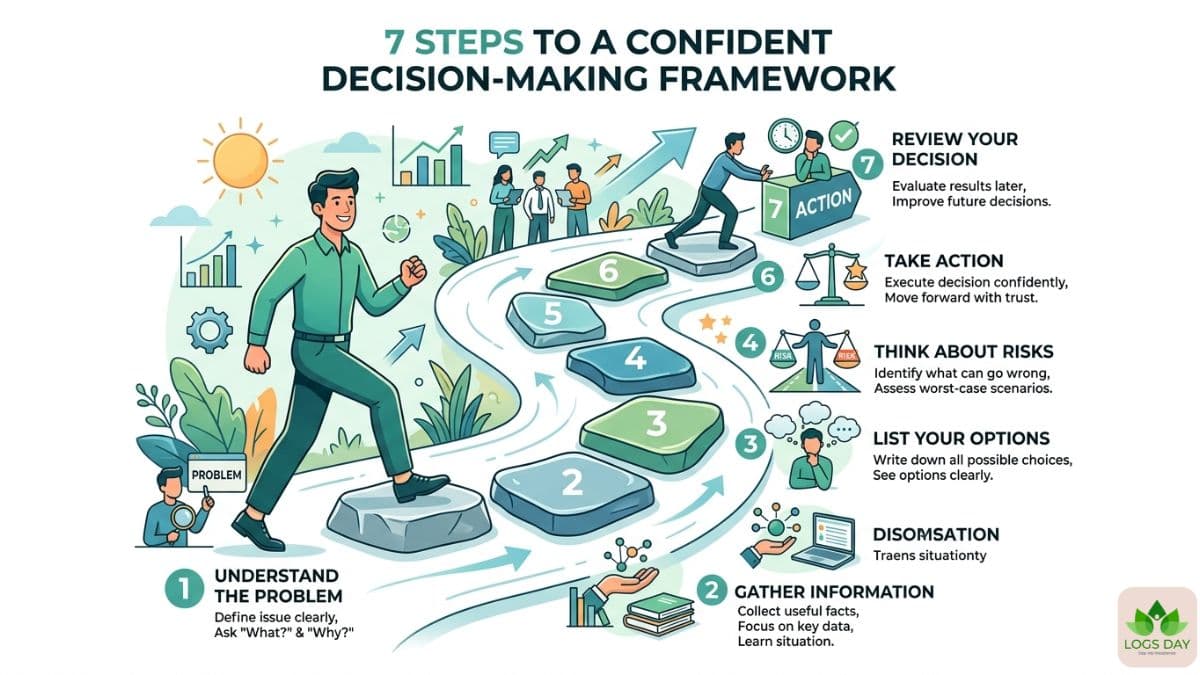
Simple Steps to Follow
Here is a very easy framework you can use in your day-to-day life:
1. Understand the Problem
First, you have to be clear about what you are deciding. Many people make mistakes simply because they do not define the problem properly.
Ask yourself:
- What exactly is the issue?
- Why does it matter?
When your problem is clear, your decision becomes a lot easier.
2. Gather Information
The next step would be to collect useful information. You do not need too much data. But you need to focus on what is really important.
This step is part of basic problem-solving methodologies. The goal is to understand your situation better before making any decision.
3. List Your Options
Write down all your possible choices. Remember that even small options matter. For example, if you are choosing a job, your options could be:
- Accept the offer
- Negotiate salary
- Look for another job
Seeing options clearly can help you think faster. It can help you take decisions with proper evaluations.
4. Think About Risks
Every decision comes with its own risks. This is where risk assessment techniques help.
Ask yourself:
- What can go wrong?
- What is the worst case?
Do not panic about risks. Just be aware of them. This helps you prepare better.
Also read: How Can You Calm and Reset Your Nervous System Every Day?
5. Compare and Decide
Now you should compare your options. Think about all the benefits and risks for each one. Choose the option that will give the best result and not just short-term happiness.
Using a decision-making framework guide will help you stay logical instead of just being emotional.
6. Take Action
Any decision is useless without proper action. Once you decide, move forward with confidence. Don’t just doubt yourself. You need to learn to trust the process.
7. Review Your Decision
After some time, check if your decision worked well. This step can help improve your future decisions. It is also a key part of good leadership and management tools.
Real-Life Examples
Let’s say you want to start a new course.
- Problem: Should I join this course?
- Information: Find out about course fees, time, and benefits
- Options: Decide whether to join now, wait, or skip
- Risks: Evaluate factors like waste of money, and time pressure
- Decision: You can join if it helps career growth
- Action: Enroll
- Review: Check progress after a few months
This is how simple a decision-making framework guide can be.
Also read: How to Be More Disciplined: 14 Strategies That Do Not Rely on Willpower
How It Helps in Personal Growth
Using a framework improves your thinking skills. You become more:
- Clear
- Calm
- Confident
It also reduces stress because you are not just guessing anymore. Many successful people strongly rely on structured thinking. They use strategic planning models as well as other tools to stay consistent in their choices.
Common Mistakes to Avoid
Even with a framework, many people make some mistakes:
- Ignoring facts and relying only on feelings
- Taking too long to decide
- Overthinking small decisions
- Not learning from past mistakes
Avoid these habits. Keep your process simple and mainly focused.
Tips to Make Better Decisions
- Note down things instead of keeping them only in your mind
- Take small steps if the decision feels big
- Talk to someone you trust
- Stay calm and avoid pressure
A decision-making framework guide works best when you stay patient and honest with yourself. Chip Heath, author and decision strategist, says the best way to make a good choice is to stop looking at just one or two options. Instead, you should try to find more paths and check if your ideas are actually right. He thinks that using simple methods or steps helps stop our personal biases from getting in the way. Basically, having a plan helps you think more clearly and make better decisions at work or at home.
Using It at Work
In offices, decisions affect many people. That is why companies use organizational decision processes.
Teams often follow systems to:
- Plan projects
- Solve problems
- Manage risks
These systems are part of leadership and management tools that help leaders guide their teams. Even if you are not a manager, using a simple framework can really improve your work performance.
Summing up
Making decisions does not have to be stressful. With the right approach, it becomes quite simple and clear. A decision-making framework guide helps you think step by step and avoid confusion.
You do not need any complex theories or complicated methods. Just follow a simple structure and stay calm. Most importantly, you need to trust your own thinking.
Over time, you will notice that your decisions improve. You will feel more confident and in control of your life. Start using this method today. Even for small choices. Try following these steps. Slowly, it will become a habit, and decision-making will feel a lot easier.
Start today, watch your confidence grow, and learn more about wellness, personal development or related topics on Logsday.
Sources
- https://www.predictiveindex.com/blog/decision-making-frameworks/
- https://www.sqcentre.com/blog/choosing-the-right-decision-making-framework-a-comprehensive-guide-for-organizational-success/
- https://www.businessballs.com/problem-solving-and-decision-making/decision-making-and-problem-solving/
- https://asq.org/quality-resources/problem-solving?srsltid=AfmBOorRlPcDvQwkJPOrJZV0Cqzs9LRBN38_n47vUQfWDgebLyz3m7In