679
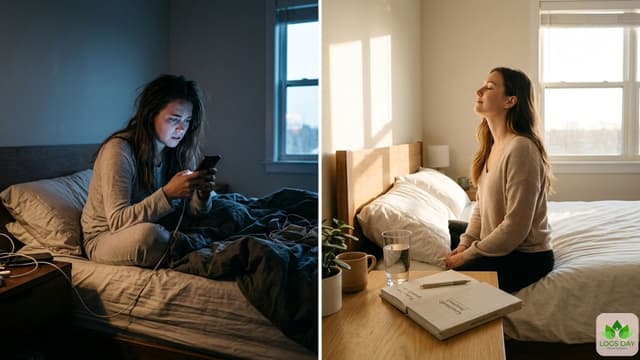
Anxiety can feel very strong. Your heart beats fast. Your chest feels tight. You feel uneasy. Your thoughts do not stop. In such moments, many people feel like they have no control. To overcome such moments, there is one thing that you can control anytime – your breath.
Breathwork for anxiety is one of the best and easiest ways to calm your body and mind too. You don’t need anything complicated. It does not need money, special tools, or any special training sessions. All you need is a few minutes and the right method.
In this article, you’ll learn how your breathing affects your body and discover 6 easy techniques to calm anxiety quickly.
How Breathing Directly Affects the Nervous System
Our body has a nervous system that controls how you feel. There are two main parts:
- Sympathetic system – this is the stress system (fight or flight)
- Parasympathetic system – this is the calm system (rest and relax)
When you feel anxious, your body goes into stress mode. Your breathing becomes fast, short and from the chest. This gives signal to your brain that there is danger.
When you slow down your breath, your body physically starts to relax. Your heart rate drops, your muscles loosen up, and your mind finally gets some peace and quiet. This is why breathing exercises work so well for stress—they basically tell your nervous system to calm down right away.
Neuroscientist Andrew Huberman explains that breathing is one of the fastest ways to control your mental state. He highlights that the physiological sigh can calm the body very quickly. This shows why breathwork works fast during anxiety. This is why breathwork for anxiety works so quickly – it directly calms your nervous system.
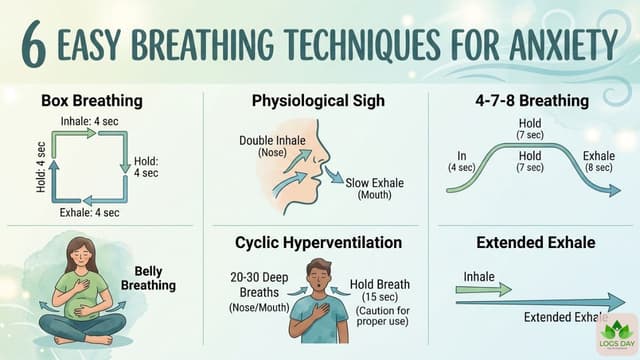
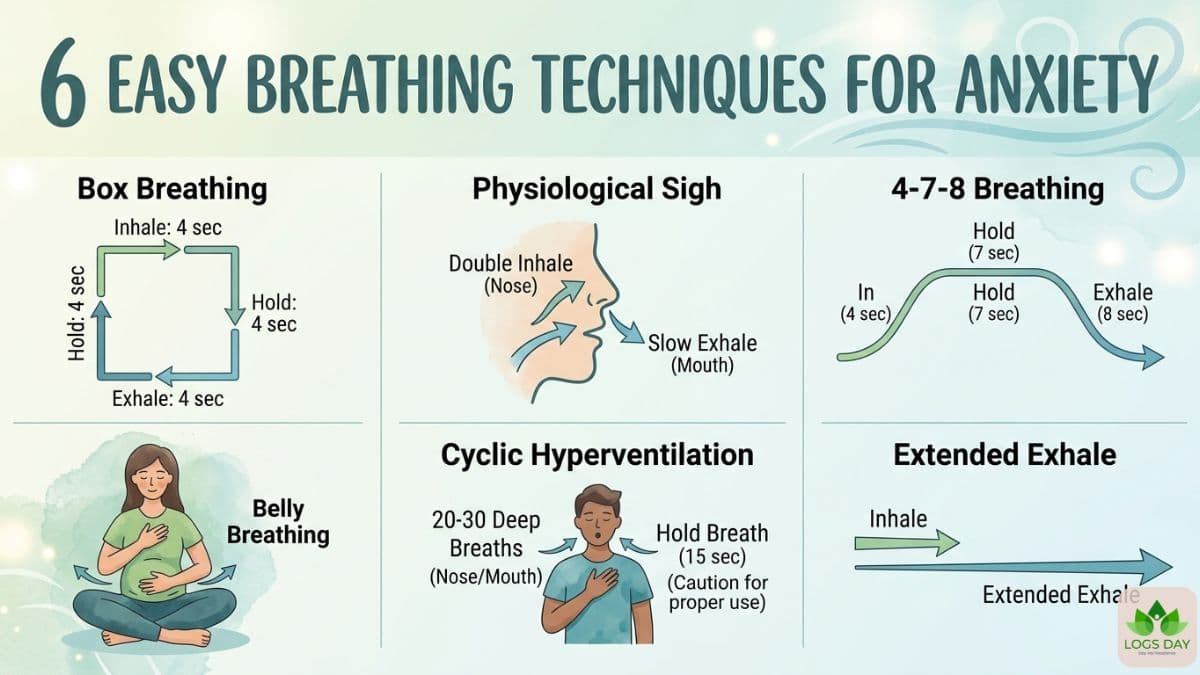
1. Box Breathing
![[image]](https://admin.logsday.com/storage/media/Box_Breathing_2026-05-03_16-37-12_bJBaaLkP.jpg)
One of the easiest methods is Box Breathing. It’s great for when you need to feel more in control. When you slow your breathing down, it actually signals your brain to stop stressing. Your heart stops racing and you just feel more in control. A really easy way to do this is called box breathing.
How to do it:
All you do is breathe in for a count of four, hold it for four, and then let it out for another four. Hold for four more seconds before you start again. If you do that a few times, you’ll notice your body starts to loosen up. It’s called "box" breathing because you're basically just spending the same amount of time on every step—like drawing a square in your head.
Why it works:
Holding the breath helps to slow down your system and brings control back to the body.
When to use:
- Before going for important conversation
- During stress at work
- When thoughts feel out of control
This is one of the easiest anxiety breathing exercises for beginners.
Also read: Struggling With Anxiety? Try This Simple Morning Emotional Wellness Routine
2. Physiological Sigh (Fastest Relief Method)
![[image]](https://admin.logsday.com/storage/media/Physiological_Sigh_2026-05-03_16-38-52_8ooI2cKq.jpg)
It’s a proven method that actually works to calm you down fast. Science backs it up, and you’ll feel the difference almost immediately.
How to do it:
All you have to do is take a long breath in through your nose, then take a quick second inhale. Then, just breathe out slowly through your mouth. Doing this about 5 to 10 times can give quick relief. It’s a solid, science-backed trick that actually works to calm you down in the moment. This is called the physiological sigh.
Why it works:
The reason this works is pretty simple. It helps your body get rid of extra carbon dioxide and lets your lungs relax fast. When that happens, it signals your brain that you are finally safe to relax.
When to use:
It’s honestly a lifesaver when anxiety hits you out of nowhere and you feel like you can’t catch your breath or your chest gets tight. Out of all the different anxiety breathing exercises out there, people usually find this one to be the fastest way to feel better.
According to Richard P Brown and his team, slow and controlled breathing can quickly shift the body from stress to relaxation. This is why the physiological sigh works so effectively in moments of sudden anxiety.
3. 4-7-8 Breathing (Deep Relaxation Method)
![[image]](https://admin.logsday.com/storage/media/4-7-8_Breathing_2026-05-03_16-40-41_rE2wKyP6.jpg)
A lot of people use this method to quiet their mind and finally get some sleep.
How to do it:
Breathe in through your nose for 4 seconds, and then hold it for 7. After that, slowly let the air out through your mouth for 8 seconds. Doing this about 4 or 5 times usually does the trick to help you relax. This is called 4-7-8 breathing.
Why it works:
Breathing out slowly like that really helps your body loosen up, while the pause in between is great for quietening down all those extra thoughts.
When to use:
This is perfect for right before you head to bed, or if you wake up in the middle of the night feeling anxious. It’s also a great way to just slow things down when your mind is racing and you can't seem to stop thinking.
This is among the most effective breathing techniques anxiety specialists recommend for immediate relief.
4. Cyclic Hyperventilation
![[image]](https://admin.logsday.com/storage/media/Cyclic_Hyperventilation_2026-05-03_16-42-04_Nm64I56q.jpg)
This is a more active breathing method. It can help release stress stored in the body.
How to do it:
Try a few rounds of cyclic hyperventilation to clear your head. It’s pretty straightforward. First, take about 20 to 30 deep breaths. Breathe in deep through your nose and let it out through your mouth. Once you’ve finished those, blow all the air out and hold your breath for as long as you feel okay.
When you can't hold it anymore, take a big breath in and hold that for 15 seconds. That’s one round—just repeat the whole thing 2 or 3 times and you’re good to go.
Most important:
- Always do this sitting or lying down
- Do not do it if you feel dizzy or light-headed
- Avoid if you have any health issues without taking proper advice
Why it works:
It changes oxygen and carbon dioxide levels in your body, which can reset your stress response. It helps in breaking that physical loop of feeling stressed out most of the time.
When to use:
This is great for those moments when you just feel stuck or emotionally heavy. It’s also a solid move if you're feeling sluggish and need a quick burst of energy, or if you can literally feel stress tightening up your body and need to shake it off.
This is a more advanced form of breathwork for anxiety, so be gentle and start slowly.
Also read: Evening Emotional Wellness Habits For A Calm Mind
5. Belly Breathing (Basic Daily Practice)
![[image]](https://admin.logsday.com/storage/media/Belly_Breathing_2026-05-03_16-48-47_jc5vNkMS.jpg)
This is honestly the most natural way to breathe, and it's completely safe for basically everyone.
How to do it:
Find a comfy spot to sit or lie down. Put one hand on your chest and the other on your stomach. As you breathe in slowly through your nose, focus on making your belly move out while keeping your chest still. Then, just let the breath out slowly and keep those rhythms going for about 5 to 10 minutes.
Why it works:
It activates the calming part of your nervous system and also reduces stress signals.
When to use:
- For your daily practice
- To help mild anxiety attacks
- After a long tiring day
This is one of the most important anxiety breathing exercises to build a strong base. Dutch-American psychiatrist and author, Bessel van der Kolk explains that learning to control your breath helps your body feel safe again. This is why simple daily breathing practices like belly breathing are so powerful.
6. Extended Exhale Breathing (Quick Calm Method)
![[image]](https://admin.logsday.com/storage/media/Extended_Exhale_Breathing_2026-05-03_16-50-17_4dasYBi6.jpg)
This method is very simple and works really quickly.
How to do it:
All you have to do is inhale through your nose for a 4-count, then slowly breathe out for 6 to 8 seconds. It might feel a bit slow at first, but just stick with it for 5 to 10 minutes. It’s a great way to calm your system down.
Why it works:
A longer exhale tells your brain that it is safe to relax.
When to use:
- When your heart beats fast
- When you feel restless
- Before sleep
This is another powerful breathwork for anxiety method that is effective and easy to follow.
When to Use Each Technique
Different situations need different breathing styles.
- Box Breathing – Perfect for when you need to focus or get back in control
- Physiological sigh – Use this as a quick fix for sudden anxiety or panic
- 4-7-8 breathing – The best choice for deep calm and sleep
- Cyclic hyperventilation – Great for those moments when you need more energy or a physical release
- Belly breathing – A simple habit for feeling more balanced and calm
- Extended exhale – A simple trick to help your body relax quickly when you're feeling tense.
Choosing the right method makes breathwork for anxiety more effective.
Also read: Feel Calm Instantly: Body Scan Meditation Technique For Deep Relaxation
Simple Practice Schedule
You do not need a lot of time. Just small daily practice is enough.
Morning (5 Minutes)
- Try belly breathing or cyclic hyperventilation to get your day started.
Afternoon (2-3 minutes)
- Use box breathing or an extended exhale to reset during a break.
Evening (5-10 minutes)
- Stick with 4-7-8 breathing to help you wind down for the night.
During anxiety (anytime)
- Go with the physiological sigh whenever you feel that sudden hit of stress.
Wrapping Up
Anxiety may feel strong, but your breath is stronger. You carry it with you all the time. Breathwork for anxiety is simple, natural, and backed by science. It works fast and can be used anywhere.
Start with one method. Practice every day. Slowly, your body will learn to stay calm. Your breath is your special tool. Use it whenever you need it.
Explore our collection of intentional wellness reads on LogsDay—your home for mindful, simple living.
Sources
- https://www.webmd.com/balance/what-to-know-4-7-8-breathing
- https://psychsolutions.ca/the-science-of-physiological-sigh-insights-from-huberman-lab/
- https://www.healthline.com/health/box-breathing
- https://www.bhf.org.uk/informationsupport/heart-matters-magazine/wellbeing/breathing-exercises
- https://www.medicalnewstoday.com/articles/324417