
2052
Learn how much stevia is too much, the ADI limits set by FDA and JECFA, and safe daily intake examples by body weight.
September 5, 2025— Stevia is everywhere today. From diet sodas to protein powders, this plant-based sweetener has made its way into daily life. Many people are happy to replace sugar with stevia because it has zero calories. But a common question is now rising across households, gyms, and online wellness groups: how much stevia is too much?
Health experts say that the answer lies in understanding something called the ADI, or Acceptable Daily Intake. Different regulatory bodies, including the U.S. Food and Drug Administration (FDA) and the Joint FAO/WHO Expert Committee on Food Additives (JECFA), have already set these safe intake levels. The good news is that stevia is considered safe when consumed within these limits.
But what do these numbers mean for you? And how can you calculate your own daily safe zone? Let’s break it down in very simple terms.
What Is ADI and Who Sets It?
To understand safe stevia intake, we first need to know about ADI. The Acceptable Daily Intake is the amount of a substance you can consume every day over your lifetime without health risk. It is usually measured in milligrams per kilogram of body weight.
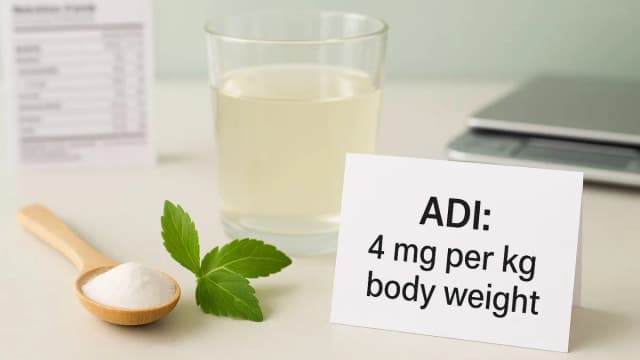
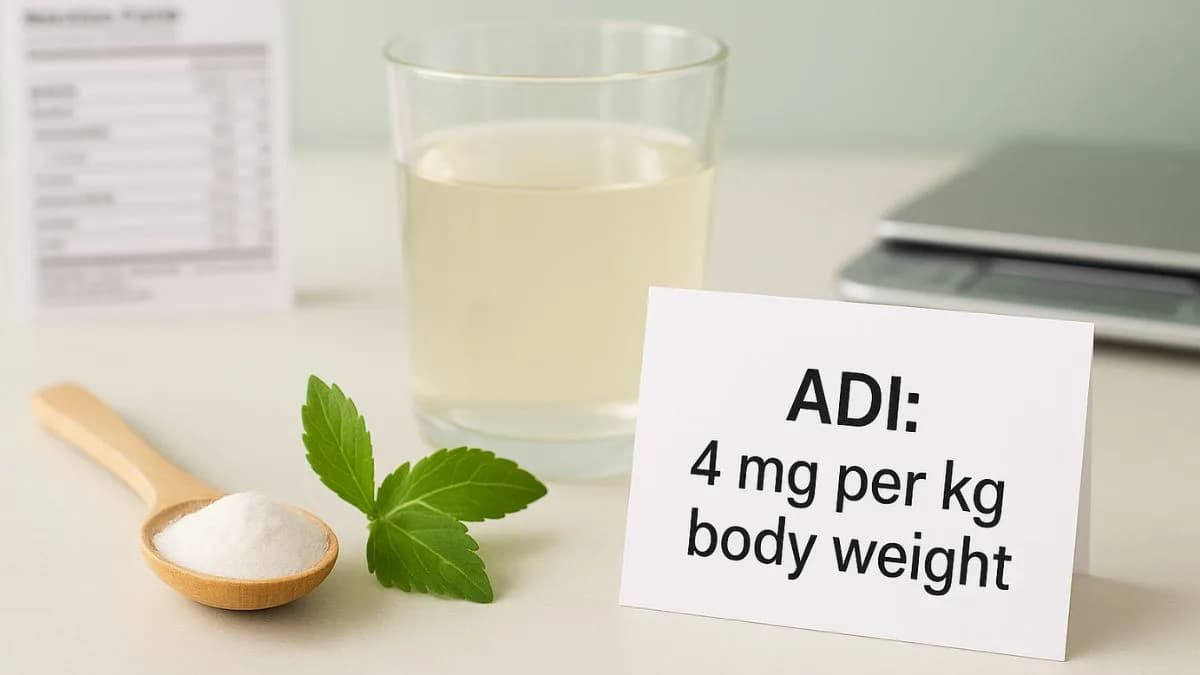
For stevia, the ADI is 4 mg per kilogram of body weight per day. Both JECFA and the FDA recognize this number as safe. That means the calculation depends on how much you weigh.
If you weigh 60 kg, your ADI for stevia is 240 mg per day. If you weigh 80 kg, your limit goes up to 320 mg per day. These numbers are simple math, but many people never think about them. Instead, they often ask: “Is stevia safe daily?” The answer is yes, if you stay under the ADI.
This approach helps health bodies create guidelines that keep both children and adults safe. Stevia is not harmful when consumed responsibly. But like every food additive, it is not safe if taken far beyond the recommended limit.
How Much Stevia Per Day by Weight?
Now, let’s look at how these numbers play out in real life. Say you are a person who drinks flavored water with stevia. One serving might contain about 30 mg of steviol glycosides. If you weigh 70 kg, your ADI is 280 mg. That means you can safely enjoy up to nine servings before hitting your daily limit.
But here is the twist. Stevia is not only in your drinks. It also hides in cereals, energy bars, sauces, and even chewing gum. Many people forget to add up all these small doses. This is why experts recommend that you check product labels carefully.
Still, reaching the ADI is difficult for most people. You would need to consume an unusually large number of sweetened products in a single day. Studies show that average intake usually falls far below the maximum limit. That means stevia is safe daily for the general population.
Think of it like a budget. If your spending limit is 280 mg and you only use 100 mg, you are well within your safe zone. The ADI is not a target. It is simply a ceiling that tells you how much is too much.
Why People Worry About Stevia Safety
Stevia often sparks debate online. Some people worry about long-term health effects. Others think that “natural” always means safe, but that is not true either. Even natural products can have side effects if consumed beyond safe limits.
Earlier this week, a Times of India article titled “8 common sugar alternatives that may be bad for your health; know the hidden health risks” highlighted rising concerns about sugar alternatives. Many experts explained that while sweeteners help reduce sugar intake, they are not magic bullets. Overuse can confuse taste buds and lead to cravings. The same principle applies to stevia. Balance is key.
Doctors also remind people that stevia does not cancel out the need for a healthy diet. Fresh fruits, vegetables, grains, and proteins still matter more. Stevia is just a tool to cut down on sugar, not a free pass to load up on processed foods.
Stevia Safety Guidelines in Simple Words
Here are some very easy rules to follow:
- Know your ADI: 4 mg per kg of body weight.
- Calculate your safe daily intake once, and remember it.
- Check product labels for stevia content.
- Do not treat ADI as a target. Stay comfortably below it.
- Remember that balance in your diet is more important than chasing numbers.
With these steps, you will always know how much stevia per day by weight is right for you.
The Handy Part
To make things even easier, you can use a simple Acceptable Daily Intake (ADI) calculator for noncaloric sweeteners—which includes stevia. Just enter your body weight, and the tool will instantly show your ADI for stevia based on the 4 mg/kg guideline. This calculator is available on the National Association for Food & Water Acceptability (NAFWA) website, under their “Acceptable Daily Intake Calculator of Noncaloric Sweeteners” tool.
You can even download or print the daily-use guide from there and keep it handy in your kitchen or wallet. It’s a smart way to make informed choices at the grocery store or café.
This calculator is made for global readers—whether you’re in the U.S., India, or Europe, the underlying science remains the same. The 4 mg/kg ADI applies universally. That’s why knowing the number and customizing it to your own weight is the safest and most personalized way to use the natural sweetener.
The Final Word
So, how much of it is too much? The simple answer is: more than 4 mg per kilogram of your body weight per day. For most people, this means several servings of stevia-sweetened foods or drinks. In reality, average consumption falls far below that limit.
Stevia is one of the safest sugar alternatives available today. The FDA and JECFA continue to support its safety. But like every food ingredient, moderation matters. It can be a friend in your wellness journey if used wisely.
Want to make your health choices simpler? Stay connected with Logsday for reliable health insights.
For more practical tips on wellness, nutrition, and balanced living, check out Logsday Lifestyle.
Sources
https://www.usatoday.com/story/life/health-wellness/2025/09/04/is-stevia-bad-for-you/85653183007
WHO | JECFA
https://www.efsa.europa.eu/en/press/news/ans100414
https://pmc.ncbi.nlm.nih.gov/articles/PMC10731492
https://www.verywellhealth.com/does-stevia-raise-blood-sugar-11746526